Key Takeaways:
- Japandi interior combines Japanese minimalism and Scandinavian warmth, creating calm, functional spaces that are well-suited to Singapore’s compact homes and lifestyle.
- Successful Japandi design relies on quality materials, concealed storage, warm lighting, and thoughtful craftsmanship, rather than simply buying minimalist furniture.
- While it requires a higher upfront investment, Japandi offers a timeless, low-clutter aesthetic that remains practical and relevant for Singapore homeowners in 2026.
You’ve seen Japandi Interior Design everywhere — on renovation blogs, Instagram feeds, and Pinterest boards. Calm, warm, unhurried. Pale oak furniture. A single ceramic vase. A plant in the corner that actually looks like it belongs there. Linen that’s slightly rumpled in exactly the right way.
And if you’re a Singapore homeowner wondering whether it’s right for your space — or whether it’s just a passing aesthetic trend you’ll regret committing your renovation budget, this guide gives you the honest, complete answer.
What Is Japandi Interior Design?
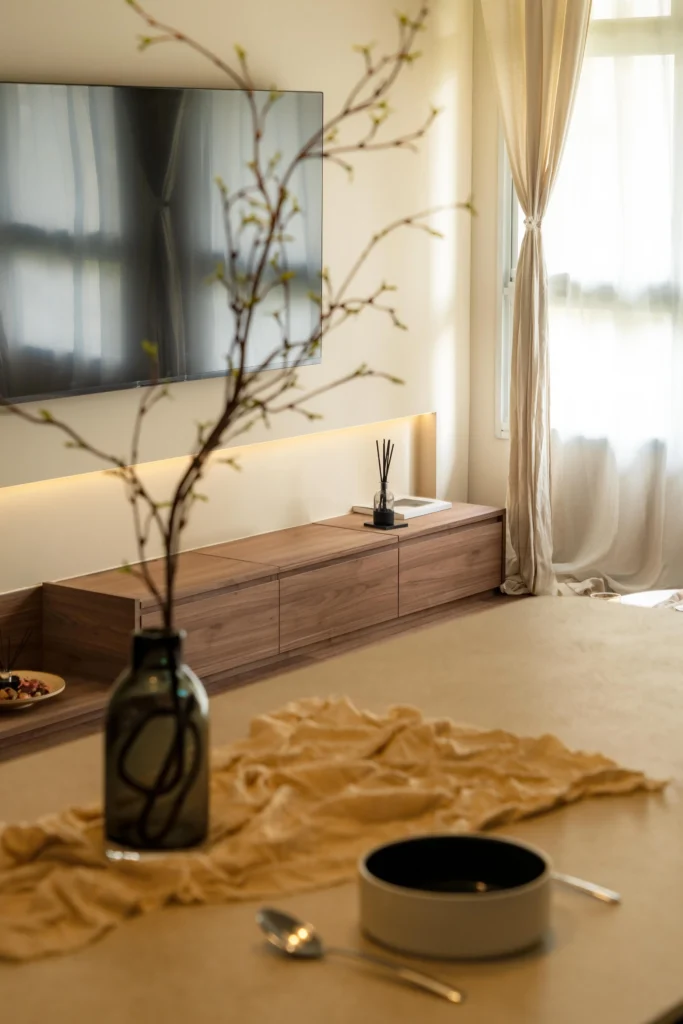
Japandi is a hybrid design style that merges two distinct but philosophically compatible cultural traditions: Japanese minimalism and Scandinavian warmth, forming a harmonious blend of Japanese and Scandinavian interior design. The name is a portmanteau — Japanese + Scandinavian = Japandi.
But it’s not just a visual mashup. What makes Japandi coherent as a design philosophy is that both cultures share a deep respect for the same things:
- Craftsmanship over decoration
- Natural materials over synthetic ones
- Functionality as a form of beauty
- Restraint as a design virtue
- The relationship between objects and the space between them
However, where they differ—and where Japandi finds its unique tension and character—is in their emotional register. While Japanese design leans toward austerity, stillness, and the philosophical acceptance of imperfection through wabi-sabi, Scandinavian design, by contrast, embraces warmth, comfort, and the everyday pleasure of being at home through hygge. Japandi is what happens when these two sensibilities negotiate with each other.
The result: a home that is simultaneously restrained and warm, edited and liveable, minimal and deeply human.
Understanding the Two Philosophies Behind Japandi Interior Design
Wabi-Sabi — The Japanese Half
Wabi-sabi is an ancient Japanese aesthetic philosophy rooted in Zen Buddhism. It finds beauty in imperfection, impermanence, and incompleteness. In design terms, it means:
- Choosing materials that age visibly and honestly — timber that develops grain, ceramics with slight irregularities, linen that softens with use
- Embracing asymmetry over forced symmetry
- Valuing the handmade over the machine-perfect
- Finding beauty in restraint — not despite what’s absent, but because of it
Wabi-sabi is why a Japandi home can feel simultaneously humble and sophisticated. The craftsmanship is real, but it doesn’t announce itself.
Hygge (pronounced “hoo-ga”) — The Scandinavian Half
Hygge is a Danish and Norwegian concept that broadly translates to the feeling of comfort, cosiness, and wellbeing found in everyday life. In design terms, it means:
- Warm lighting that creates atmosphere rather than just illumination
- Soft textiles — linen, cotton, wool — that invite physical contact
- Spaces designed for gathering and relaxing, not just displaying
- An unpretentious quality that makes a home feel accessible, not aspirational
Hygge is what prevents Japandi from becoming too cold, too empty, or too philosophically demanding to actually live in.
Why Japandi Interior Design Works Exceptionally Well in Singapore
Japandi is not just aesthetically appealing in Singapore — it solves real problems that Singaporean homeowners face every day, especially for those drawn to warm minimalist interior design in compact city homes.
Space constraint. Most Singapore HDB flats range from 60 to 120 sqm. Japandi’s emphasis on low-profile furniture, negative space, and concealed storage makes compact homes feel genuinely larger — not just visually, but physically. Less furniture means more floor space and better movement.
Urban stress. Singapore is one of the most high-pressure cities in the world. After long commutes and intense working days, most homeowners want a home that decomposes their nervous system, not one that stimulates it further. Japandi’s muted palette, natural textures, and uncluttered layouts create genuine psychological calm — your home becomes a place of restoration.
Climate compatibility. Japandi’s light colour palette reflects heat rather than absorbing it. Additionally, its preference for natural materials—such as composite wood, linen, and rattan—makes it well suited to Singapore’s humid climate. Likewise, the style’s emphasis on natural light, sheer curtains, and unobstructed sightlines maximises the country’s abundant sunlight while promoting better airflow throughout the home
Cultural resonance. Singapore has deep cultural and economic ties with Japan — it’s consistently among Singaporeans’ most loved holiday destinations. The Japanese half of Japandi feels familiar, not foreign.
The 6 Core Elements of Japandi Interior Design
1. The Colour Palette — Warm Neutrals, Not Cold Whites
The most common misunderstanding about Japandi is that it uses white. It doesn’t — at least not cool, stark white.
The Japandi palette is built around warm neutrals: off-white, oatmeal, warm greige, soft sand, and muted taupe. One or two deeper, nature-inspired anchor tones—such as dusty charcoal, deep forest green, warm clay, or raw umber—ground the palette, while textiles and accessories introduce these colours sparingly.
The 60-30-10 Japandi rule:
- 60% — Warm neutral base (walls, large upholstered pieces, main rug)
- 30% — Secondary tone (cabinetry, flooring, curtains in light oak or warm grey)
- 10% — Accent (ceramics, cushions, a single statement plant, one artwork)
What to avoid: cool greys, blue-toned whites, high-gloss finishes, and more than three or four tones in a single room. Visual complexity undermines Japandi’s foundational quality.
2. Natural Materials — The Non-Negotiable
If there is one rule in Japandi that cannot be violated, it’s this: **no plastic, no synthetic laminates, no fake finishes.**Every material must be honest about what it is, or at least convincingly evoke a natural counterpart.
Materials that define Japandi:
| Material | Where It Works | Singapore Consideration |
|---|---|---|
| Light-toned timber (oak, ash, birch) | Flooring, cabinetry, furniture frames | Use composite wood — performs better than solid hardwood in our humidity |
| Rattan and cane | Furniture, pendant lights, room dividers | Performs well indoors; avoid direct rain exposure |
| Linen and cotton | Curtains, upholstery, bedding, cushions | Natural fibres handle Singapore humidity better than synthetic alternatives |
| Natural stone | Countertops, bathroom surfaces, feature walls | Travertine and slate work well; seal real marble against our humidity |
| Handmade ceramics | Tableware, vases, bathroom accessories | Any source; imperfection is the point |
| Bamboo | Shelving, flooring overlays, accessories | Sustainable, locally familiar, performs well in our climate |
| Raw plaster / limewash | Feature walls | Beautiful, durable, and achieves wabi-sabi texture naturally |
| The matte rule: Japandi avoids high-gloss finishes entirely. Everything is matte, brushed, or naturally textured, echoing principles found in Scandinavian interior design adapted for Singapore homes. Glossy surfaces read as synthetic, regardless of the underlying material. |
3. Furniture — Low, Purposeful, Few
Japandi furniture has two defining characteristics: it sits low to the ground and every piece has a clear purpose.
The low-to-the-ground quality is inherited from Japanese interior culture — futons, floor cushions, low dining tables. In Japandi interiors, this translates to:
- Sofas with seat heights of 35–40cm rather than the standard 45cm
- Platform beds at 25–35cm off the floor rather than elevated bed frames
- Coffee tables at 35–40cm
- Dining chairs with clean, tapered lines and clean lines overall rather than heavy, upholstered bulk
This consistent lowering of the visual centre of gravity makes rooms feel calmer, more spacious, and more grounded. In Singapore’s HDB flats, it also frees up the upper visual field of the room — making ceilings feel higher and spaces feel less enclosed.
The Japandi furniture audit: Before buying anything new, identify what you already own that should leave. The most authentic Japandi spaces are achieved through subtraction first. Remove objects, live with less for a few weeks, and discover what you actually need — rather than buying a “Japandi furniture package” that simply replaces one set of clutter with another.
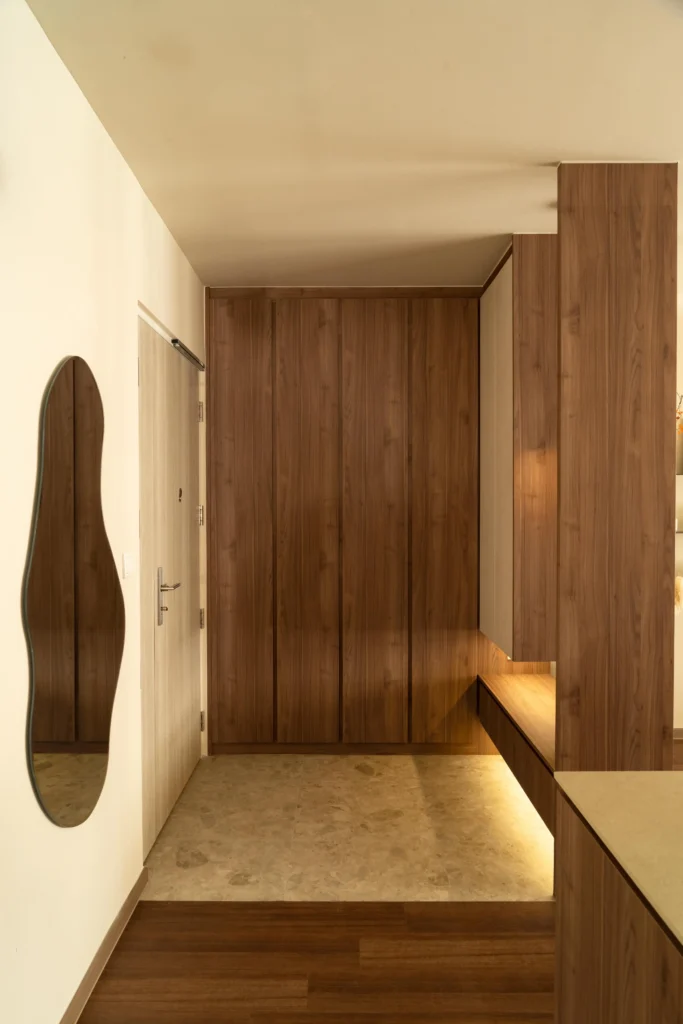
4. Joinery and Storage — Hidden, Handle-less, Seamless
In a Japandi home, storage is the backbone of the aesthetic. Everything that can create visual clutter — appliances, bags, shoes, seasonal items, children’s toys — must have a home, and that home must be invisible.
In Singapore renovations, this translates to:
- Handle-less cabinetry throughout the kitchen and bedrooms, using push-to-open mechanisms or recessed cut-outs
- Floor-to-ceiling joinery in the same tone as the walls, so storage disappears into the architecture
- Platform bed frames with deep under-bed drawers
- Built-in benches with lift-up storage at the entrance
- Concealed appliances wherever possible — the kitchen in a Japandi home has no visible kettle, toaster, or blender unless they’re in use
The carpentry is where Japandi renovation budgets go, and rightly so. Poor-quality joinery undermines the entire effect. The seamless, handle-less look requires precise fitting — gap inconsistencies become glaring in a style where perfection of line is the aesthetic point.
5. Lighting — Warm, Layered, Never Harsh
Lighting in Japandi serves one function above all: atmosphere. Not task efficiency. Not dramatic effect. Atmosphere — the quiet, warm quality of a home that feels inhabited and at rest.
Japandi lighting principles:
- Colour temperature: 2700K–3000K throughout (warm white). Never cool white or daylight bulbs — they kill the warmth of every natural material around them
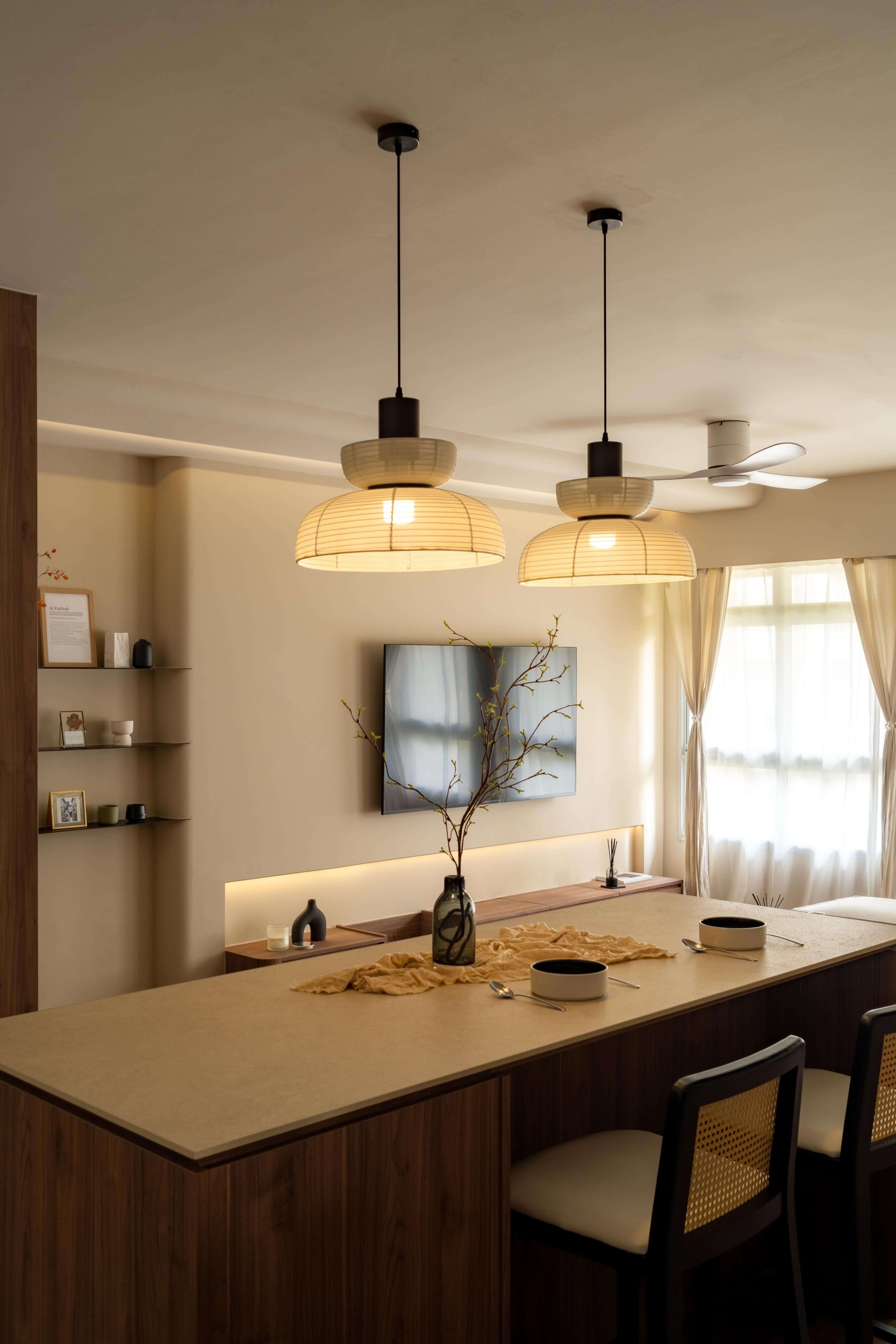
- No single-source lighting. A central ceiling fitting providing all the light in a room is anti-Japandi. Every room needs layered lighting: ambient (for overall illumination), task (for functional areas), and accent (for atmosphere)
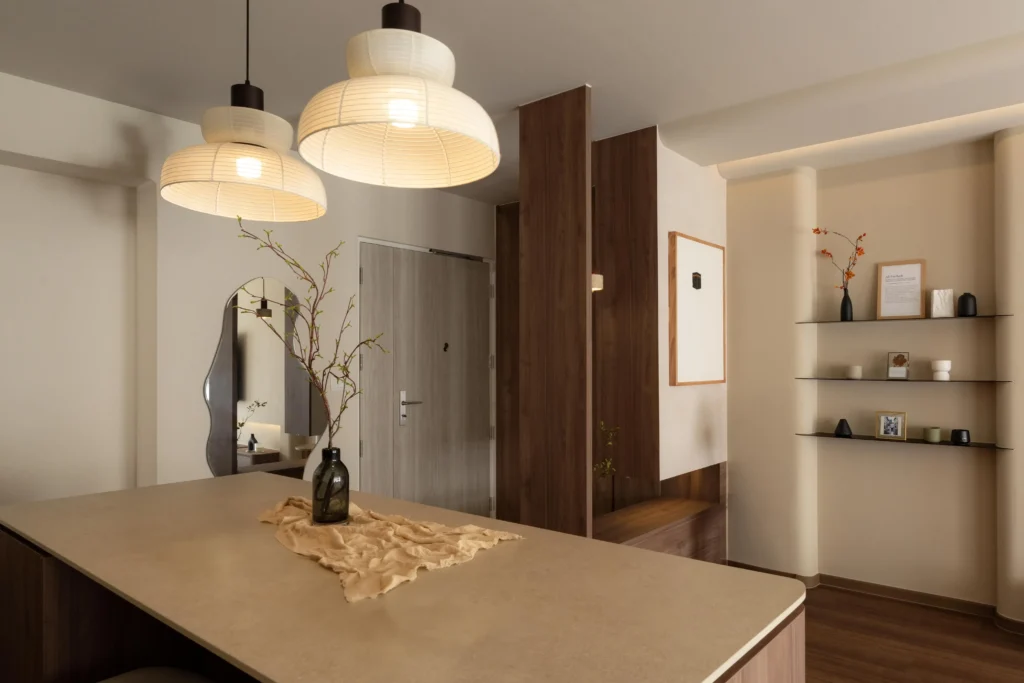
- Natural materials in light fittings: Paper pendants, rattan shades, washi diffusers, and ceramic table lamps all reinforce the material language of the style
- Dimmers on everything — the ability to lower the lighting level in the evening is not a luxury in Japandi design; it’s essential
In Singapore HDB flats, the most common lighting mistake is retrofitting warm-toned bulbs into fixtures designed for harsh overhead light. For a proper Japandi renovation, lighting needs to be planned from the architecture — recessed warm downlights at lower lux levels, supplemented by floor lamps and pendants.
6. Greenery and Nature — Deliberate, Not Decorative
Plants belong in Japandi — but placed with the same intentionality as every other element. A curated few, in considered positions, suited to the room’s actual conditions. Not a collection scattered to fill empty corners.
Best plants for Japandi homes in Singapore:
- Snake plant (Sansevieria) — architectural line, thrives in low light, suits Japandi’s vertical quality
- ZZ plant (Zamioculcas) — glossy, sculptural, extremely low maintenance
- Monstera deliciosa — bold leaf shape, strong visual presence, ideal as a single statement plant
- Pothos — trails naturally from shelves, suits the slightly imperfect quality of wabi-sabi
- Peace lily — white flowers, suits bathrooms and humid spaces
What doesn’t suit Japandi: Cacti (too graphic), flowering plants in bright colours (too energetic), and over-planted shelves that read as a collection rather than a considered choice.
One or two plants, chosen carefully, placed where they’ll thrive — this is the Japandi approach to greenery.
Japandi by Room: Singapore Applications
Living Room
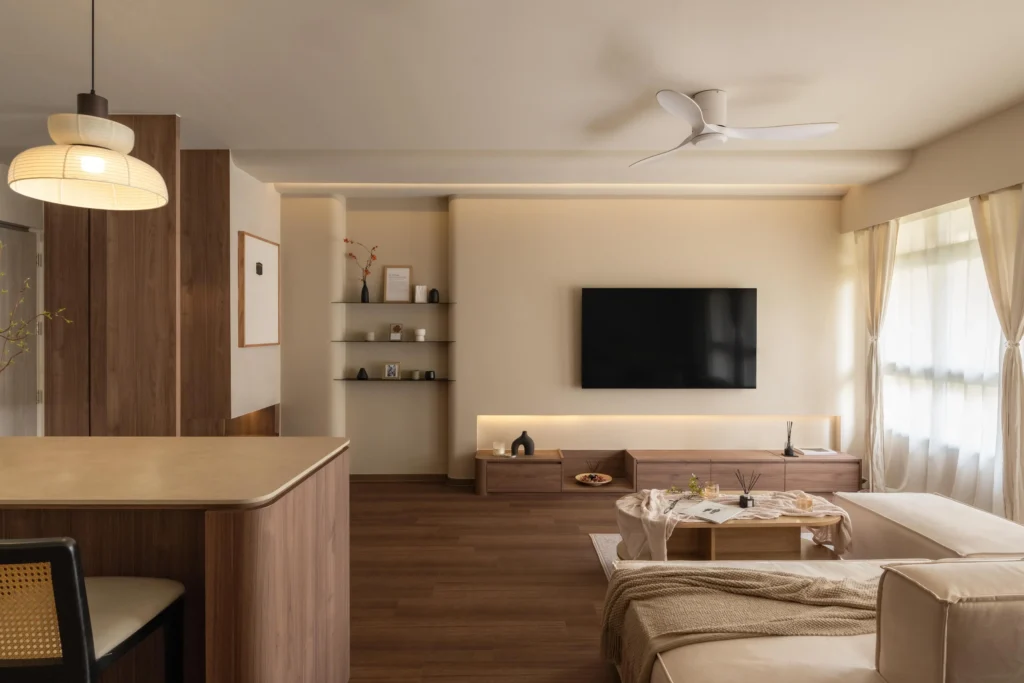
The living room is where Japandi’s low-profile approach has the most dramatic impact on a Singapore HDB flat. A low sofa — with a seat height of 35cm and arms no taller than 55cm — and a low coffee table open up the room’s upper visual field and make even a 16-sqm living area feel genuinely spacious.
Key moves:
- One continuous run of neutral colour from walls to ceiling (avoid contrasting ceiling colour)
- A timber slat feature wall behind the sofa or TV console — this single element reads as deeply Japandi without requiring a full renovation
- Sheer linen curtains floor-to-ceiling, even if the windows only extend to mid-wall (the floor-to-ceiling curtain visually increases the ceiling height)
- A single large plant as a sculptural element rather than multiple small pots
Avoid: Gallery walls, decorative objects that serve no function, television units with open shelving that fills with visual clutter
Kitchen
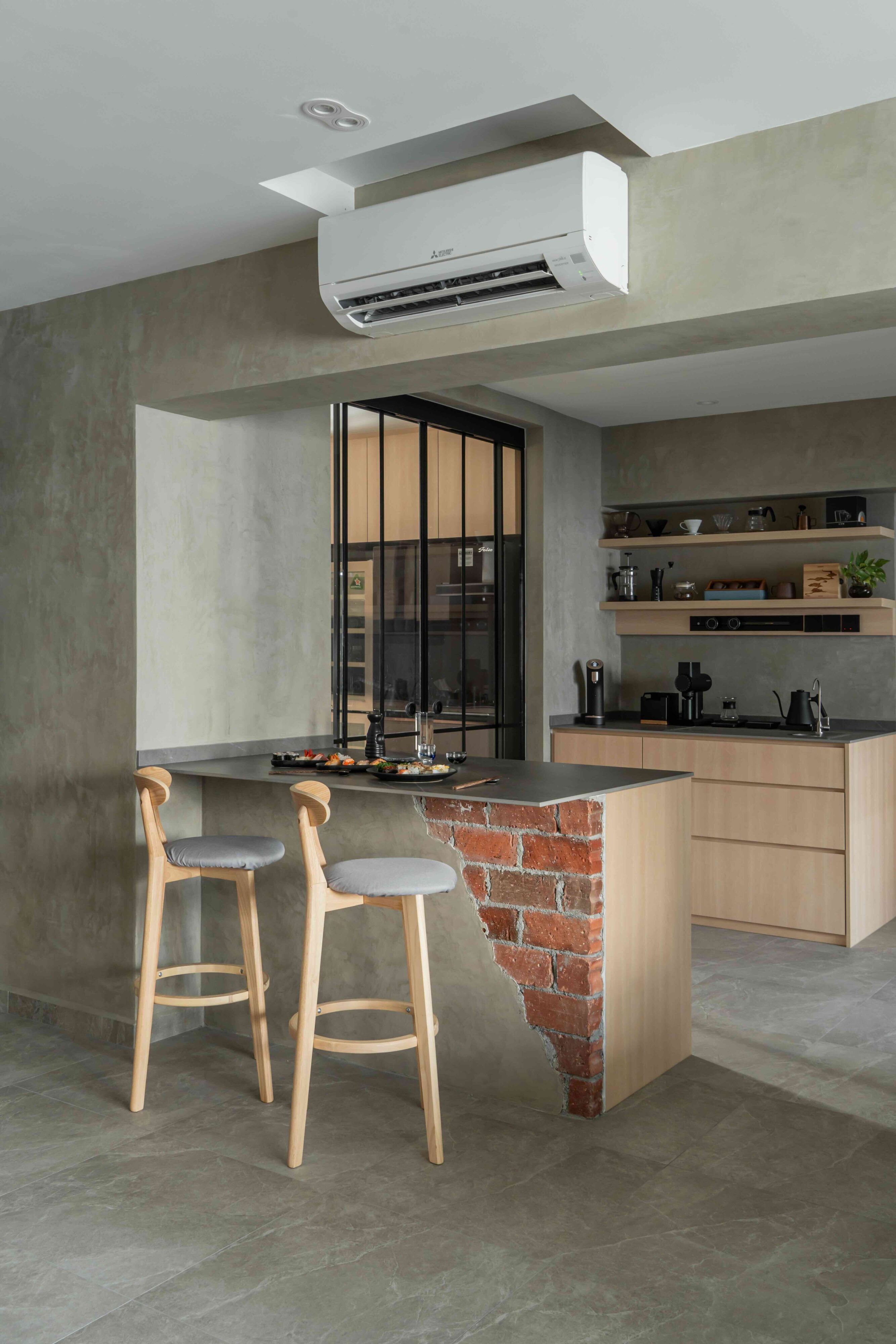
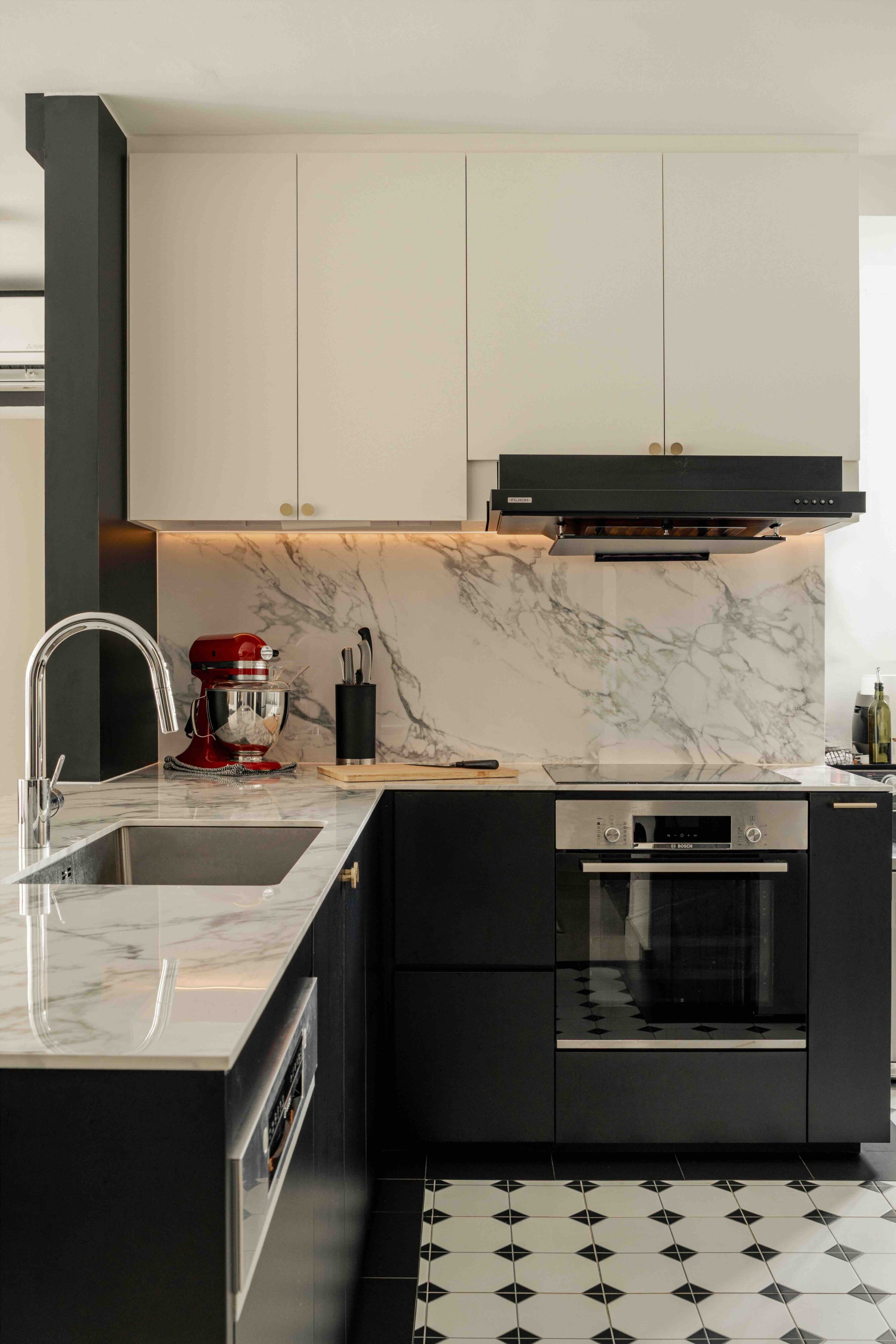
Japandi kitchens in Singapore require careful planning because the kitchen is often visible from the living and dining areas in open-concept layouts, making thoughtful kitchen design and space planning in Singapore essential.
Key moves:
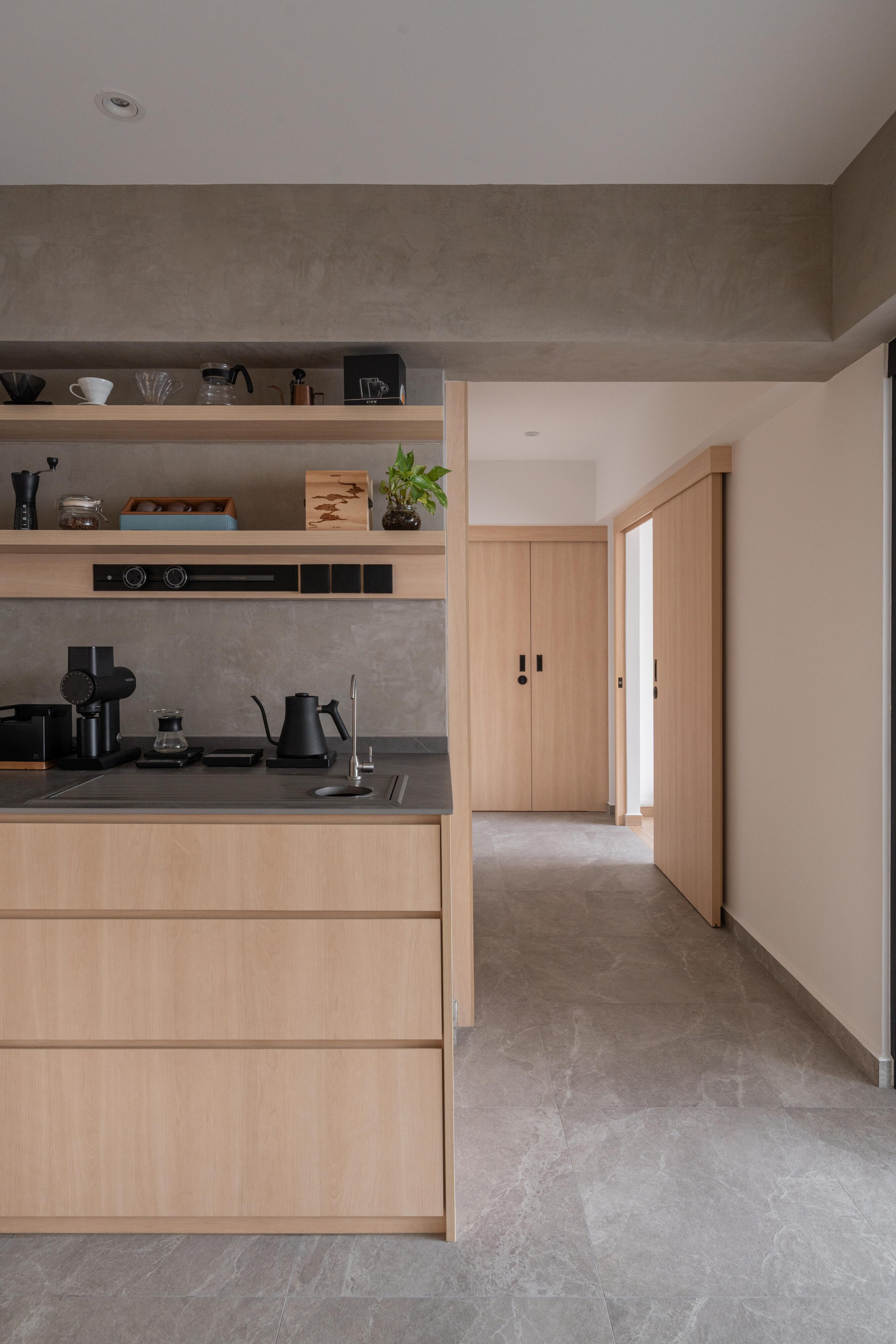
- Flat-panel cabinetry in light timber grain or warm matte finish — no Shaker profiles, which read as too decorative, and consider how a multi-functional kitchen island can anchor the space
- Handle-less doors throughout, using push-to-open mechanisms
- A natural stone or engineered stone countertop in a warm, matte finish (sintered stone is overtaking quartz in 2026 — it’s more heat-resistant and the matte versions suit Japandi perfectly, and thoughtful kitchen renovation planning in Singapore helps align these choices with your budget)
- Concealed appliances wherever HDB rules and budget allow
- A simple, open shelf or two in natural timber for items that earn display — a ceramic utensil holder, a wooden cutting board, three ceramics of varying height
Singapore-specific note: HDB rules restrict bathroom tile hacking for three years after BTO key collection, but kitchen cabinets can be replaced. For resale flats, full kitchen renovations are common and the kitchen is often the highest-impact Japandi investment.
Bedroom
The Japandi bedroom has one goal: genuine rest. Everything is subordinated to this.
Key moves:
- Platform bed frame in light oak or warm-toned timber, as low to the floor as the HVAC unit allows
- Bedding in natural linen or cotton — oatmeal, warm white, or soft sage. No patterns, or subtle texture patterns only
- A single bedside table per side, chosen for proportion rather than matching as a set
- Blackout linen curtains — warm tone, floor-to-ceiling — over any existing window treatments
- Wardrobe in the same finish as the walls: handle-less, floor-to-ceiling, invisible
What doesn’t belong: Multiple decorative cushions that must be removed before sleep, bedside tables with inadequate storage that leads to surface clutter, and pendant lights hung at a height that creates glare from bed
Bathroom
Japandi bathrooms are where the wabi-sabi influence is most visible — in the choice of slightly textured tiles, natural stone surfaces, and matte fixtures that feel deliberately honest about their materials.
Key moves:
- Large-format matte porcelain tiles in stone or concrete tones (microcement is beautiful but requires high maintenance in Singapore’s humidity — matte porcelain achieves the same aesthetic with less upkeep)
- A timber-look vanity in warm-toned composite or natural teak sealed for moisture
- Matte black or brushed brass tapware — never chrome, which reads as too corporate
- Open timber shelving for towels and a single plant (peace lily or fern) rather than mirrored cabinets
- A simple, rectangular basin rather than ornate countertop designs
How Much Does a Japandi Renovation Process Cost in Singapore? (2026)
Japandi is not the cheapest renovation style to execute well — because the materials matter. Poor-quality laminates, cheap joinery, or incorrect lighting can undermine the entire effect. But it’s one of the most cost-efficient in the long run: it doesn’t go out of style, and you won’t be replacing furniture or repainting in five years.
| Property Type | Scope | Estimated Cost Range |
|---|---|---|
| 3-room BTO (new) | Full Japandi renovation | $30,000 – $48,000 |
| 3-room HDB (resale) | Full Japandi renovation | $42,000 – $60,000 |
| 4-room BTO (new) | Full Japandi renovation | $38,000 – $58,000 |
| 4-room HDB (resale) | Full Japandi renovation | $56,000 – $80,000 |
| 5-room HDB | Full Japandi renovation | $65,000 – $95,000 |
| 2-bedroom condo | Full Japandi renovation | $45,000 – $75,000 |
| 3-bedroom condo | Full Japandi renovation | $65,000 – $110,000 |
| Where budget goes in a Japandi renovation: |
- Custom carpentry (handle-less cabinetry, platform bed, built-in storage): 35–45% of total budget
- Composite wood flooring throughout: 10–15%
- Lighting design and fixtures: 8–12%
- Kitchen surfaces and tapware: 10–15%
- Soft furnishings and loose furniture: 15–20%
The biggest trap: allocating renovation budget correctly but then filling the space with cheap furniture. Japandi requires fewer pieces, but they must be well-made. Budget for three or four quality furniture pieces rather than ten cheap ones.
Is Japandi Interior Design Right for You? An Honest Assessment
Japandi is the right choice if:
- You find visual complexity draining rather than energising
- You want a home that feels like a reset after a demanding day
- You prefer owning fewer, higher-quality belongings and keeping your home clutter-free.
- You value craftsmanship and are willing to invest in quality materials
- You want a style that won’t need updating in five years
It is probably not the right choice if: reviewing real homeowner reviews and completed interior projects can also help clarify whether this aesthetic suits how you actually live.
- You love displaying collections, artwork, and meaningful objects throughout your home
- You have young children who will turn every surface into a canvas, and maintaining the Japandi aesthetic will require consistent discipline.
- Your renovation budget is under $30,000 for a full flat — at lower budgets, the material quality that makes Japandi work is hard to achieve
- You find neutral palettes aesthetically boring — Japandi’s restraint should feel like a relief, not a deprivation. If it feels like a sacrifice, choose a different style
Japandi vs. Other Popular Singapore Interior Design Styles
| Style | Japandi | Warm Minimalism | Scandinavian | Quiet Luxury |
|---|---|---|---|---|
| Colour palette | Warm neutrals, deep accents | Earthy, warm, varied | Light, bright, white-led | Tonal, sophisticated |
| Furniture height | Low-profile | Standard | Standard | Standard to low |
| Material philosophy | Natural only; imperfection celebrated | Natural preferred | Mix of natural and practical | Premium materials, flawless |
| Clutter tolerance | Very low | Low | Medium | Very low |
| Best for | HDB flats, compact condos | All property types | Families, BTO | Larger condos, landed |
| Budget | Mid to high | Mid | Low to mid | High |
| Maintenance | Low (few surfaces) | Low | Low to medium | Medium (precision finishes) |
Common Japandi Mistakes Singapore Homeowners Make
Buying “Japandi furniture” without decluttering first. The most common and most expensive mistake. Japandi spaces achieve their effect through what’s removed, not what’s added. Before spending anything, remove everything from a room and add back only what genuinely earns its place.
Using cool-toned neutrals. Cool grey walls, blue-white paint, and cold-toned timber all undermine Japandi’s warmth. Every colour choice must lean warm — check undertones before committing.
Ignoring lighting. High-lux cool-white downlights installed throughout a home destroy the Japandi atmosphere regardless of how good the materials are. Lighting is as important as any material choice.
Over-planting. Five plants in a living room is a collection. One or two is a Japandi statement. The difference matters.
Cheap joinery. Handle-less cabinetry with inconsistent gaps and poor-quality laminates looks worse than standard cabinetry. Japandi’s precision of line requires quality execution.
Adding too much too soon. After a renovation, resist the urge to fill every surface. Live in the space for two to four weeks before adding anything. You will consistently discover you need less than you thought.
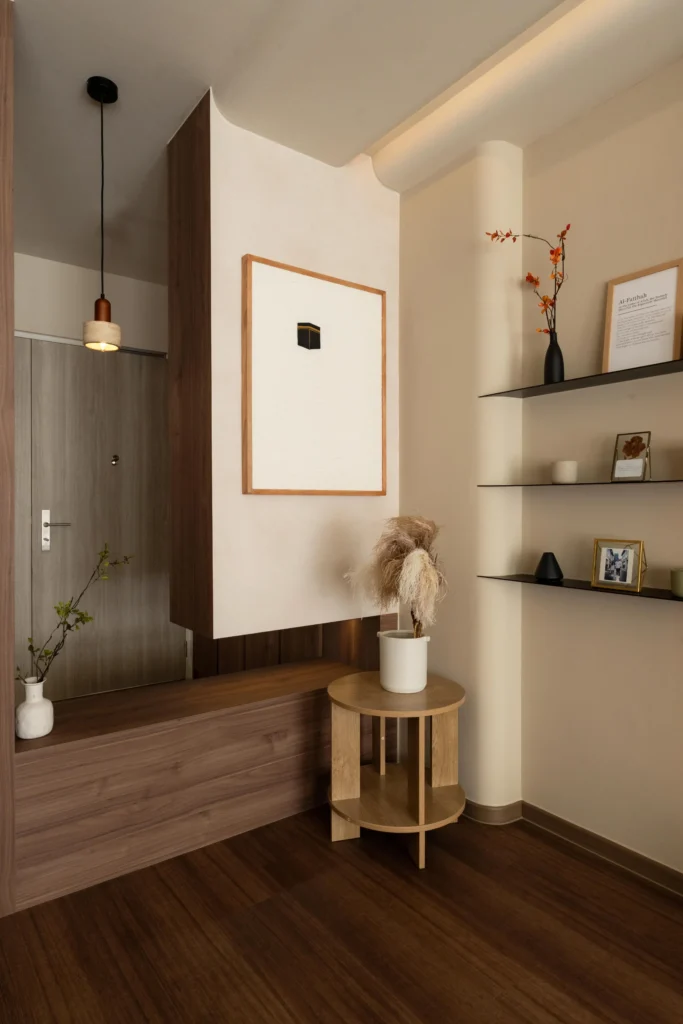
Final Thoughts
Japandi is a timeless design philosophy that combines simplicity, warmth, and functionality to create homes that feel calm and effortlessly liveable. Whether you’re renovating a compact HDB flat or a spacious condominium, thoughtful planning, quality materials, and well-crafted details are key to achieving an authentic Japandi interior. By understanding its core principles and adapting them to your lifestyle, you can create a home that not only looks beautiful today but continues to feel relevant and comfortable for years to come.
Frequently Asked Questions
Japandi is a hybrid interior design style that blends Japanese minimalism with Scandinavian warmth. The Japanese influence brings wabi-sabi — an appreciation for imperfection, natural materials, and restrained simplicity. The Scandinavian influence brings hygge — warmth, comfort, and the pleasure of everyday living. Together they produce interiors that are simultaneously edited and liveable, minimal and human.
Both share natural materials, neutral palettes, and a love of functionality. The key differences are emotional tone and material temperature, which become clearer when you examine Scandinavian interior design tailored for Singapore. Scandinavian design is lighter and brighter — white walls, pale woods, an open, cheerful quality. Japandi is warmer and more restrained — muted rather than bright, with darker wood tones and a philosophical depth that Scandi doesn’t claim. Japandi asks what can be removed; Scandinavian asks what can add warmth.
Yes — and it may be the style best suited to Singapore’s most common living conditions. Japandi’s low-profile furniture, emphasis on negative space, and integrated concealed storage make small flats feel meaningfully larger. The muted palette reflects Singapore’s natural light without creating glare. And the philosophy of owning fewer, better things directly addresses the storage challenge of compact HDB living.
The Japandi palette is built on warm neutrals: off-white, oatmeal, warm greige, soft sand, taupe, and muted clay. These are grounded by one or two deeper nature-derived accent tones — dusty charcoal, forest green, raw umber, muted terracotta — used in textiles and accessories. Cool greys, stark whites, and vibrant colours are avoided entirely.
No. Japandi has passed its trend peak and is now settling into something more durable: a widely adopted design philosophy rather than a passing aesthetic. Its values — restraint, natural materials, functionality, psychological calm — respond to pressures in modern life that aren’t going away. In Singapore, where space pressure and urban stress remain constants, Japandi’s relevance is structural, not fashionable. Homes designed well in this style in 2020 look as current in 2026 as they did when they were completed.
The core materials are light-toned timber (oak, ash, birch) in composite or engineered form, rattan and cane, linen and cotton textiles, natural stone surfaces, handmade ceramics, and bamboo. All finishes are matte or naturally textured — Japandi avoids high-gloss surfaces entirely. In Singapore’s climate, composite wood flooring is preferred over solid hardwood, and matte porcelain tiles are used in wet areas where microcement would require excessive maintenance.
Yes, but it requires honesty about storage and maintenance. The style works best for families when storage is genuinely comprehensive — every toy, school bag, and piece of equipment has an assigned home, ideally concealed. Japandi’s emphasis on durable natural materials and matte finishes (which show less wear than glossy alternatives) suits family life well. The harder challenge is discipline: Japandi requires ongoing editing to maintain its quality. For families who want the aesthetic without the daily effort, Warm Minimalism offers similar warmth with slightly more tolerance for the natural accumulation of family life.
Minimalism in its purest form is conceptual — it pursues the absolute reduction of all elements toward a theoretical zero. Japandi is warmer, more human, and more liveable. Where minimalism can feel cold, empty, and even hostile to the presence of humans, Japandi is edited but not austere. The warmth of natural materials, soft textiles, and considered greenery give Japandi a quality of lived-in calm that pure minimalism doesn’t achieve. A minimalist home can feel like a gallery; a Japandi home should feel like a retreat.